Overview
Have you reached the stage where you need to write your hypothesis? Are you unsure whether to choose a non directional vs directional hypothesis? This is one of the most common questions I hear from dissertation students. The answer depends on your research question, previous research, and the evidence available. A non directional hypothesis simply tests whether a difference or relationship exists. A directional hypothesis goes one step further by predicting the direction of that difference or relationship. Choosing the correct approach helps you select the right statistical test and strengthens your dissertation from the beginning.
Why Does a Hypothesis Matter?
Every dissertation starts with an idea.
You may notice a problem.
You may ask a question.
You may wonder if two variables are connected.
A hypothesis gives that idea a clear direction.
It tells readers exactly what the study will examine.
It also guides every stage of the research process.
From choosing participants to selecting statistical tests, the hypothesis plays an important role.
I often tell my doctoral students that a strong hypothesis makes the rest of the dissertation much easier to write.
What Is a Research Hypothesis?
A research hypothesis is your expectation.
It is written in a positive way.
It explains what you believe will happen in your study.
For example, you may expect that students who spend more time studying will earn higher grades.
Or you may believe there is a relationship between job satisfaction and employee performance.
These statements are based on research, professional knowledge, or previous studies.
They should never be simple guesses.
Good hypotheses are supported by evidence.
What Is a Null Hypothesis?
Many students find this part confusing.
The null hypothesis is different from the research hypothesis.
It is always written in the negative.
Why?
Because statistics test the null hypothesis, not the research hypothesis.
The word hypothesis comes from Greek and means an assumption that can be tested.
During statistical analysis, one of two things happens.
Researchers either accept the null hypothesis, or they fail to reject it.
This means the study did not find enough evidence of a difference or relationship.
The other possibility is that researchers reject the null hypothesis.
When that happens, the research hypothesis is supported by the results.
This process helps researchers make conclusions based on evidence instead of opinions.
How Are Directional and Nondirectional Hypothesis Different?
This is where many dissertation students become uncertain.
The good news is that the difference is easy to understand.
A non directional hypothesis does not predict which group will score higher or lower.
It only asks whether a difference or relationship exists.
For example:
“There is no difference between online students and classroom students in their final exam scores.”
The researcher is simply looking for a difference.
No prediction is made about which group performs better.
A directional hypothesis is different.
It predicts the direction of the outcome.
For example:
“Online students will not have higher final exam scores than classroom students.”
In this case, the researcher expects one group to perform differently.
However, this prediction should never be based on personal opinion.
It should come from previous research, theory, or professional experience.
I always encourage students to review the literature before writing a directional hypothesis.
Strong evidence should support every prediction.
Quick Comparison
| Feature | Non-Directional Hypothesis | Directional Hypothesis |
| Makes a prediction | No | Yes |
| Tests for | Difference or relationship | Difference or relationship with a predicted direction |
| Based on previous evidence | Helpful | Essential |
| Common statistical test | Two tailed test | One tailed test |
| Best used when | The outcome is uncertain | Strong research supports the prediction |
When Should Each Type Be Used?
There is no single answer.
It depends on the purpose of the study.
If earlier research does not clearly show what to expect, I usually recommend a non directional hypothesis.
It allows the researcher to test whether a difference exists without predicting the result.
A directional hypothesis should only be used when strong evidence already exists.
That evidence may come from published studies.
It may come from accepted theory.
Sometimes it comes from years of professional experience.
A directional hypothesis should never be chosen because it sounds more impressive.
It should always be supported by facts.
Research methods textbooks also explain that one tailed tests should only be used when a clear directional prediction is justified.
Choosing the wrong type of hypothesis can affect the statistical analysis later in the dissertation.
Many students overlook this point until they begin analyzing their data.
That is why I encourage students to think carefully before writing their hypotheses.
How Does the Hypothesis Affect Statistical Testing?
The type of hypothesis does more than shape the research question.
It also affects the statistical test.
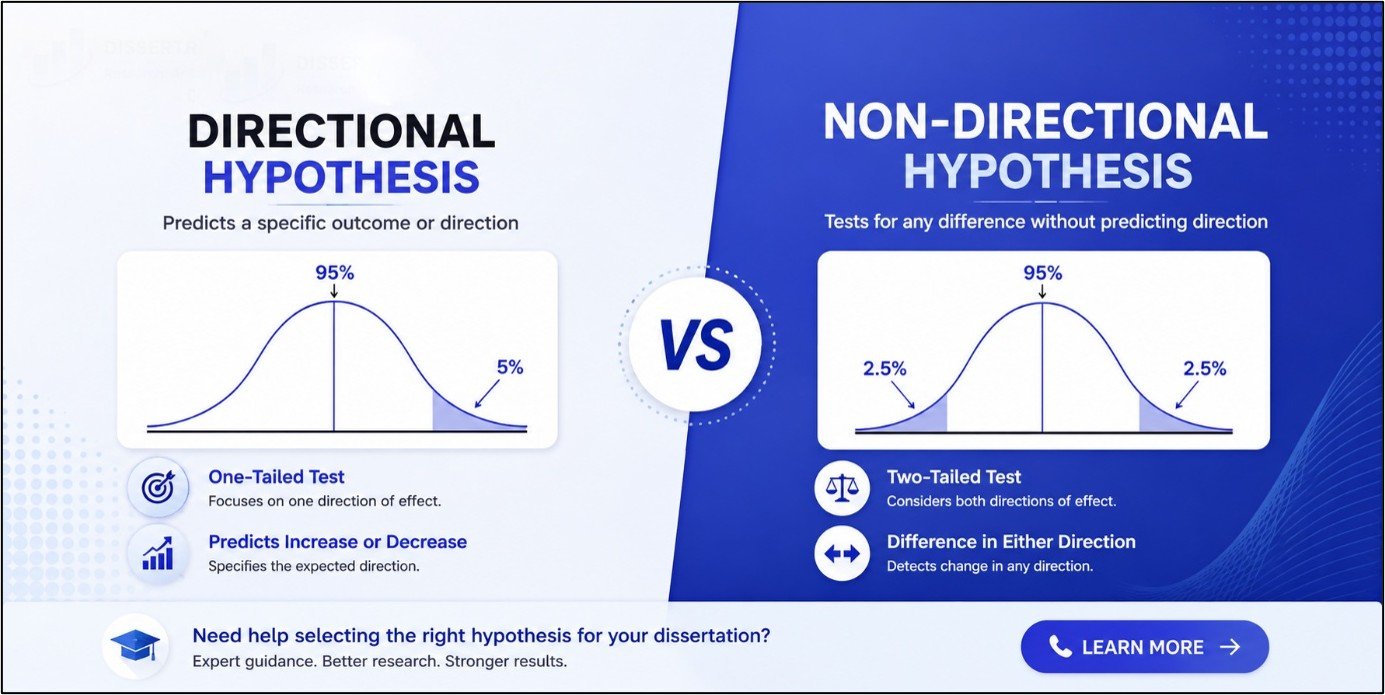
A non directional hypothesis is usually linked with a two tailed test.
A two tailed test checks whether a difference exists in either direction.
The result may be higher.
It may be lower.
The test looks at both possibilities.
A directional hypothesis usually goes with a one tailed test.
This type of test looks for a result in only one expected direction.
That is why researchers should choose it only when there is strong evidence to support their prediction.
Another important decision is the probability level, often called the significance level.
Many researchers use 0.05.
This means there is a 5 percent chance of making the wrong decision when rejecting the null hypothesis.
The probability level helps researchers decide how strict they want to be when testing their hypothesis.
What Happens After the Statistical Test?
After collecting and analyzing the data, researchers compare the results with the null hypothesis.
There are only two possible outcomes.
The first is to accept the null hypothesis or fail to reject it.
This means the study did not find enough evidence of a difference or relationship.
The second is to reject the null hypothesis.
This means the results show that a difference or relationship exists.
When this happens, the research hypothesis is supported.
Many students think rejecting the null hypothesis means the study is perfect.
That is not true.
It simply means the data provides enough evidence to support the research hypothesis.
The findings should still be discussed carefully and compared with previous studies.
What Are Type I and Type II Errors?
Statistics is never completely free from error.
That is why researchers learn about Type I and Type II errors.
A Type I error happens when the null hypothesis is rejected even though it is actually true.
In simple words, the researcher believes there is a difference when there really is not.
A Type II error is the opposite.
The researcher accepts the null hypothesis even though a real difference actually exists.
Researchers try to reduce these errors by choosing suitable statistical tests, selecting an appropriate sample size, and planning the study carefully.
Good research design helps lower the chance of making these mistakes.
Why Is Power Analysis Worth Considering?
Another useful step is power analysis.
Many students hear this term but are not sure what it means.
Power analysis helps estimate the sample size needed before the study begins.
A sample that is too small may not detect a real difference.
An unnecessarily large sample can make the research more expensive and time consuming.
Planning the sample size early improves the quality of the research.
It also increases the chances of detecting meaningful results when they truly exist.
I encourage students to think about power analysis during the planning stage rather than after the data has already been collected.
What Mistakes Do Dissertation Students Commonly Make?
Over the years, I have noticed the same mistakes appear again and again.
Some students choose a directional hypothesis without enough evidence.
Others write a research hypothesis but forget to include a matching null hypothesis.
Some use statistical tests that do not match their hypothesis.
Another common mistake is changing the hypothesis after looking at the data.
The hypothesis should guide the research from the beginning.
It should not be rewritten to fit the results.
Careful planning saves time later and makes the dissertation much stronger.
Closing Thoughts
Choosing between directional and nondirectional hypothesis is an important decision because it influences the research design, statistical testing, and interpretation of the findings. I always encourage students to begin with a clear research question, review the published literature carefully, and select the type of hypothesis that best fits the available evidence. A thoughtful approach at the beginning often leads to a smoother dissertation journey.
Research has shown that Dissertation support plays an important role in helping doctoral students complete their degrees successfully. ( source). If you need expert guidance with your dissertation, consider consulting Dissertation Statistics by Dr. Susan Carroll. I have helped doctoral students complete their degrees sooner, with less stress and without breaking the bank. I am also the author of Simplifying Statistics for Graduate Students, written to make statistics easier to understand. Learn more at https://www.dissertation-statistics.com/.
Frequently Asked Questions
- What is the difference between a non directional and directional hypothesis?
A non directional hypothesis looks for a difference or relationship without predicting the outcome. A directional hypothesis predicts which direction the difference or relationship will take. The choice depends on the research question and the strength of previous evidence supporting the prediction.
- When should a directional hypothesis be used?
A directional hypothesis should only be used when previous studies, accepted theories, or professional experience strongly suggest a particular outcome. It should never be based on a personal opinion or a simple guess because it affects the choice of statistical testing.
- Why is the null hypothesis important?
The null hypothesis is the statement tested during statistical analysis. It assumes that no difference or relationship exists. Researchers either reject it or fail to reject it based on the evidence collected during the study.
- What is the connection between hypotheses and statistical tests?
The type of hypothesis helps determine which statistical test is appropriate. Non directional hypotheses are commonly associated with two tailed tests, while directional hypotheses are usually linked with one tailed tests when there is sufficient evidence for a predicted outcome.
- What are Type I and Type II errors?
A Type I error happens when a researcher concludes that a difference exists when it actually does not. A Type II error happens when a real difference exists, but the researcher fails to detect it. Careful study design, appropriate sample sizes, and suitable statistical methods help reduce these risks.
- How can students write a stronger dissertation hypothesis?
Students should begin with a clear research question, review relevant literature, and ensure the hypothesis is specific, measurable, and supported by evidence. The hypothesis should match the research design and remain consistent throughout the dissertation process.
Author Bio
This blog is prepared by the team at Dissertation Statistics by Dr. Susan Carroll. The objective is to provide clear, practical, and easy to understand guidance that helps graduate and doctoral students build stronger research studies, understand statistics with confidence, and complete successful dissertations.
Business Details
Dissertation Statistics by Dr. Susan Carroll
Website: https://www.dissertation-statistics.com/
Dissertation Statistics by Dr. Susan Carroll provides expert support in dissertation statistics, research methods, quantitative and qualitative analysis, hypothesis testing, research design, survey development, SPSS guidance, and dissertation consulting for master’s and doctoral students. Dr. Susan Carroll is also the author of Simplifying Statistics for Graduate Students, a practical resource designed to make statistical concepts easier to understand.