
Common Mistakes When Selecting Sampling Strategies for Dissertation
Choosing the right sampling strategies for dissertation research is one of the most important decisions you will make during your doctoral journey. I often tell my students that even the best research question cannot produce reliable findings if the wrong sample or sampling method is used. A proper calculation and an appropriate sampling strategy improve the accuracy, reliability, and credibility of your results. As a dissertation statistics consultant, I have helped hundreds of doctoral students avoid these mistakes. In this guide, I explain the most common sampling errors, how to avoid them, and how to select a sampling strategy that matches your research design.
Why Do Sampling Strategies Matter in Dissertation Research?
One of the biggest misconceptions I see among doctoral students is believing that collecting more data automatically leads to better research. That is not true. What matters is collecting the right data from the right participants.
A sample is a smaller group selected from the population you want to study. Your sample should accurately represent that population. Your sample size is simply the number of participants included in your research.
Statistics allow researchers to make reliable conclusions without studying every member of a population. Instead of surveying thousands of people, you can collect information from a carefully selected sample and use statistical methods to draw meaningful conclusions.
This approach saves time, reduces research costs, and allows you to complete your dissertation more efficiently.
What Is the Difference Between a Sample and Sample Size?
Many students confuse these two concepts.
A sample refers to the people, organizations, schools, hospitals, or other units selected for your research.
A sample size refers to how many participants are included in that sample.
For example, if your research examines leadership among public school principals in Texas, your population includes every public school principal in Texas. If you survey 300 principals, those 300 individuals are your sample, while 300 is your sample size.
Understanding this difference is essential before selecting strategies for dissertation research.
Why Is Sample Size Calculation So Important?
Another mistake I frequently encounter is choosing a sample size based on convenience instead of statistical evidence.
Many students simply decide to collect responses from 100 participants because another dissertation used that number. Unfortunately, this approach often creates problems during dissertation review.
A proper sample size calculation considers several important factors, including:
- The research design
- Statistical analysis
- Expected effect size
- Desired statistical power
- Significance level
- Population size
Researchers commonly use statistical software such as G*Power to calculate the minimum number of participants needed for quantitative studies.
Research published across social science disciplines generally recommends statistical power of 0.80, meaning there is an 80 percent chance of detecting a meaningful effect if one truly exists. This recommendation has become the accepted standard for many quantitative dissertation studies.
Selecting too few participants increases the likelihood of inaccurate conclusions. Selecting substantially more participants than necessary increases costs, time, and effort without providing meaningful additional benefits.
What Are the Most Common Mistakes When Selecting Sampling Strategies for Dissertation?
Over the years, I have reviewed thousands of dissertation proposals. The same sampling mistakes appear repeatedly.
- Choosing Convenience Instead of Scientific Justification
Convenience sampling is sometimes appropriate, particularly in exploratory or qualitative research. However, many doctoral students use convenience sampling simply because it is easier.
Your sampling strategy should always match your research objectives rather than your personal convenience.
- Ignoring the Target Population
Many students define their research questions broadly but collect data from a much narrower group.
For example, a researcher studying university faculty may collect responses from only one department. This limits the ability to generalize findings to the broader faculty population.
Clearly defining your target population before selecting participants improves both validity and credibility.
- Using the Wrong Sampling Strategy
Different research designs require different sampling approaches.
For example, probability sampling methods generally provide stronger external validity in quantitative studies, while purposive sampling often produces richer insights in qualitative research.
Choosing the wrong strategy can weaken your entire dissertation, even if your statistical analysis is technically correct.
- Forgetting to Explain the Sampling Method
Another common problem is assuming readers understand why a particular sampling method was selected.
Your dissertation committee expects a clear explanation describing:
- Why the sampling strategy was chosen
- How participants were selected
- Why the sample represents the population
- How sample size calculation was performed
Providing this justification strengthens the methodological quality of your dissertation.
Should You Study the Entire Population?
Many doctoral students ask whether they should study everyone instead of selecting a sample.
In most dissertation studies, studying the entire population is impractical because it requires excessive time, funding, and resources.
Using a scientifically selected sample allows you to make evidence based conclusions while keeping your research manageable.
In my own consulting work, I encourage students to focus on selecting a representative sample rather than attempting to include everyone. This approach almost always leads to a smoother dissertation process and stronger research findings.
Which Sampling Strategy Should You Choose for Your Dissertation?
There is no single sampling strategy that works for every dissertation. The right choice depends on your research question, research design, target population, and statistical analysis. Before selecting participants, I encourage my students to answer a few important questions.
- Do you need to generalize your findings to a larger population?
- Is your research quantitative, qualitative, or mixed methods?
- Can every member of the population be identified?
- Do you have enough time and resources to collect data?
Answering these questions helps you select a sampling strategy that supports your research objectives rather than creating unnecessary limitations.
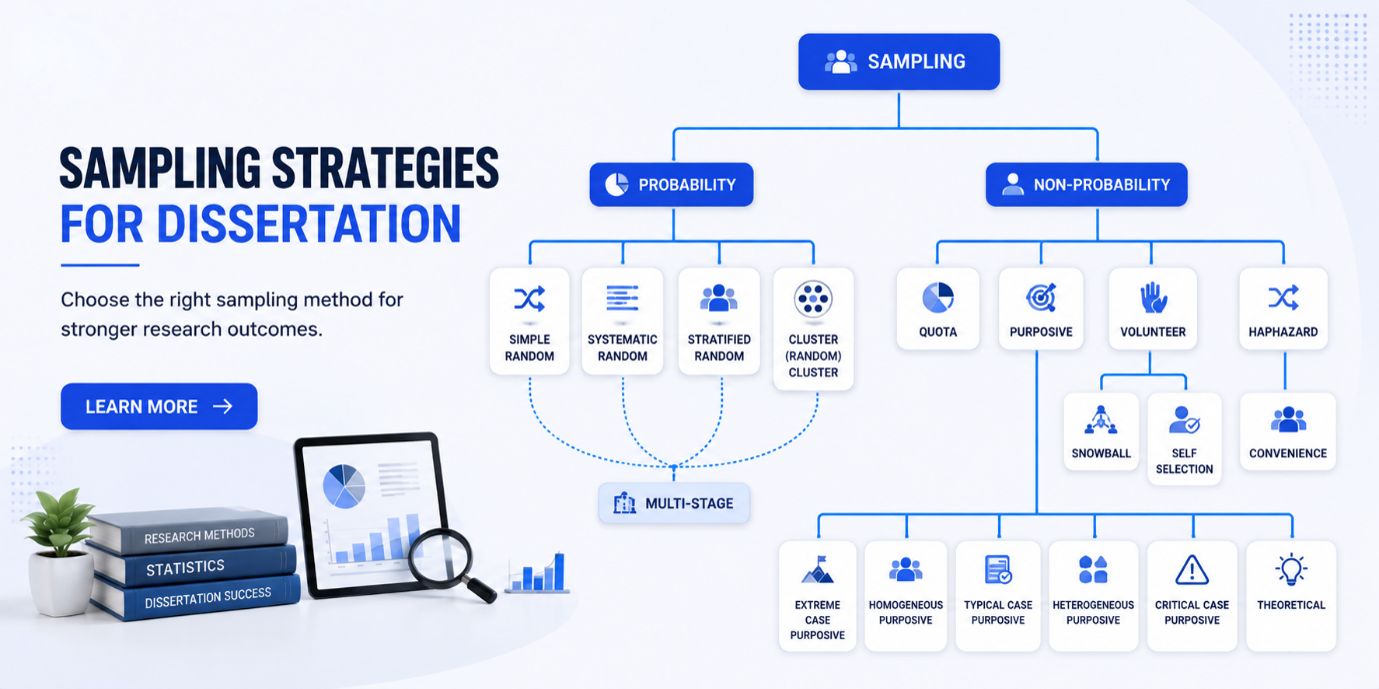
For quantitative research, probability sampling methods often provide the strongest evidence because every member of the population has a known chance of being selected. Common examples include simple random sampling, stratified sampling, cluster sampling, and systematic sampling.
For qualitative research, non probability sampling methods are usually more appropriate because the goal is to obtain rich, detailed information rather than statistical generalization. Purposive sampling, snowball sampling, and convenience sampling are frequently used depending on the research context.
How Do Probability and Non Probability Sampling Compare?
| Sampling Strategy | Best Used For | Main Advantage | Common Limitation |
| Simple Random Sampling | Quantitative studies | Reduces selection bias | Requires a complete population list |
| Stratified Sampling | Diverse populations | Improves representation of subgroups | More planning required |
| Cluster Sampling | Large geographical populations | Reduces data collection costs | Slightly lower precision |
| Systematic Sampling | Ordered population lists | Easy to implement | Can introduce bias if patterns exist |
| Purposive Sampling | Qualitative research | Selects information rich participants | Limited generalizability |
| Convenience Sampling | Pilot or exploratory studies | Fast and inexpensive | Higher risk of sampling bias |
| Snowball Sampling | Hard to reach populations | Helps recruit hidden participants | Participants may share similar characteristics |
How Can You Calculate the Right Sample Size?
One of the most common questions my doctoral students ask is, “How many participants should my study include?”
Unfortunately, there is no universal answer. Every dissertation requires its own sample calculation based on the research design and planned statistical analysis.
For example, a study using multiple regression often requires a different sample size than a study using an independent samples t test or structural equation modeling.
Several factors influence sample size calculation.
- Population size
- Expected effect size
- Statistical power
- Significance level
- Number of variables
- Planned statistical test
Instead of guessing, I always recommend using accepted statistical methods or software to justify your sample size. A properly documented calculation demonstrates methodological rigor and gives your dissertation committee confidence in your research design.
How Do You Draw a Random Sample?
Students often assume random sampling is difficult. In reality, the process can be straightforward.
Suppose your population includes 1,000 employees.
First, assign every employee a number from 1 to 1,000.
Next, use a random number generator to select the required number of participants.
This approach ensures that all employees have an equal likelihood of being selected. This process reduces selection bias and strengthens the credibility of your findings.
If a complete list of participants is unavailable, another sampling strategy may be more appropriate. Choosing the method that fits your research situation is always more important than forcing a particular technique.
What Other Sampling Questions Should You Answer Before Collecting Data?
As you plan your dissertation, ask yourself the following questions.
- Should I study the entire population or use a sample?
- How large should my sample be?
- Which sampling strategy best fits my research design?
- Can I realistically obtain a random sample?
- Will my sample accurately represent my target population?
Answering these questions before collecting data can prevent major revisions later in your dissertation.
Throughout my career, I have found that students who spend time planning their sampling strategy experience fewer methodological problems and complete their dissertations more efficiently.
I also discuss these concepts in my book, Simplifying Statistics for Graduate Students, where I explain statistical methods in clear, practical language designed specifically for doctoral researchers. My goal has always been to make statistics less intimidating so students can focus on producing high quality research rather than struggling with complicated statistical terminology.
Closing Thoughts
Selecting the right sampling strategies for research is far more than a methodological requirement. It forms the foundation of trustworthy research. A carefully planned sampling strategy, supported by an appropriate sample data calculation, improves the reliability, validity, and credibility of your findings.
I have worked with doctoral students from many universities, and I have seen how proper statistical planning helps students complete their degrees sooner, reduce unnecessary stress, and avoid expensive revisions. If you are unsure about your sampling strategy, sample calculation, or statistical analysis, consider consulting with me before you begin collecting data. Expert guidance early in the research process can save you significant time and effort while strengthening the quality of your dissertation.
Frequently Asked Questions
- What are sampling strategies for dissertation research?
Sampling strategies for dissertation research are methods used to select participants from a larger population. Choosing the appropriate strategy helps ensure that your findings accurately represent your target population and supports reliable statistical analysis. The choice depends on your research design, objectives, and available resources.
- Why is sample size calculation important?
A proper sample size calculation ensures that your study includes enough participants to detect meaningful results while avoiding unnecessary data collection. It improves statistical power, supports valid conclusions, and strengthens the credibility of your dissertation methodology.
- Which sampling strategy is best for quantitative research?
Probability sampling methods, such as simple random sampling, stratified sampling, cluster sampling, and systematic sampling, are generally preferred for quantitative research because they reduce selection bias and improve the ability to generalize findings to the target population.
- Which sampling method is commonly used in qualitative research?
Qualitative studies often use purposive sampling because researchers intentionally select participants who have relevant knowledge or experience. Snowball sampling and convenience sampling may also be appropriate depending on the research question and participant availability.
- Can I use convenience sampling in my dissertation?
Yes, convenience sampling can be appropriate in some studies, particularly exploratory or qualitative research. However, you should clearly justify why it fits your research objectives and acknowledge its limitations regarding the generalizability of your findings.
- How can I justify my sampling strategy to my dissertation committee?
Explain how your sampling strategy aligns with your research questions, study design, target population, and statistical analysis. Include a clear justification for your sample size calculation and describe how participants were selected. A transparent explanation strengthens the credibility of your methodology.
Author Bio
This blog has been prepared by Dr. Susan Carroll team. Their objective is to simplify dissertation statistics and research methods so graduate students can confidently design, analyze, and complete high quality research. Drawing on Dr. Susan Carroll’s extensive experience in dissertation consulting and her book, Simplifying Statistics for Graduate Students, they provide practical guidance that helps doctoral candidates finish their degrees sooner, reduce stress, and avoid unnecessary research costs.
Business details
At Dissertation Statistics, Dr. Susan Carroll specializes in dissertation statistics, quantitative and qualitative research methods, sample size calculation, survey design, statistical analysis, and dissertation methodology support for master’s and doctoral students. She provides personalized statistical consulting to help students develop rigorous research designs, select appropriate sampling strategies, interpret results accurately, and successfully complete their dissertations with confidence.